


In This Issue
First Taste
The freebie is not (just) a generous gift. It's the proof.
There's a reason fine restaurants send out an amuse-bouche. One small bite, chosen by the chef, tells you exactly what the kitchen can do, and you settle in for the tasting menu because of it. Your freebie is doing the same work: a buyer reads it as the first bite of the paid experience, your clarity, standards, and your level of care.
From Behind University Paywalls...
The Research
Think about the last time you bought an offer from someone new. You could read the promise, admire the page, scroll testimonials, but the thing itself stayed sealed: the only way to know what it was really like was to buy it.
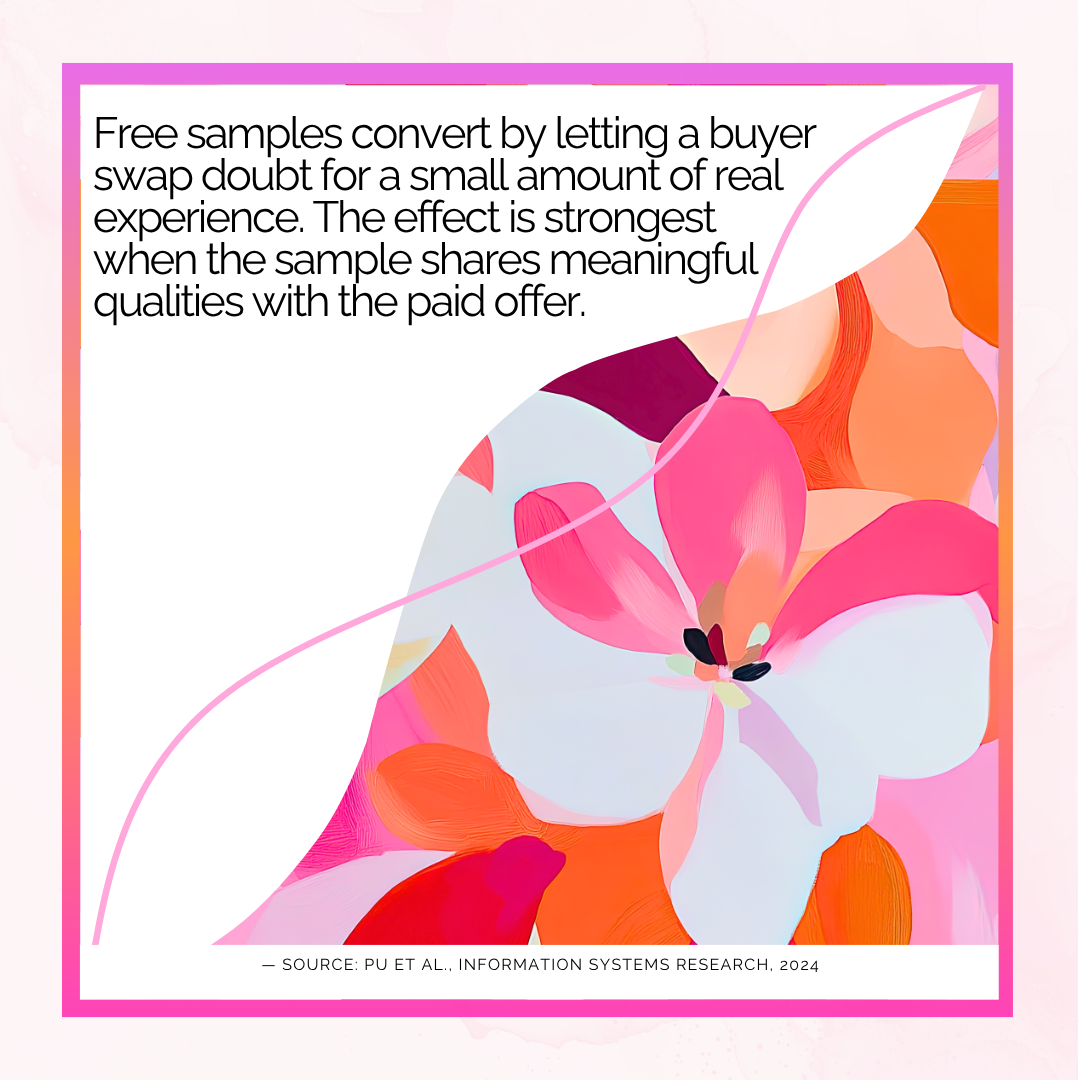
Researchers call offers like these experience goods, and in 2023 a team studying online free sampling in the Journal of Electronic Commerce Research measured exactly what a small taste does inside that sealed-box moment.
Shi, H., Cai, S., & Luo, X. (2023). Online free product sampling: The reciprocity and diagnosticity effects. Journal of Electronic Commerce Research, 24(3), 194-214.
This finding shifts established wisdom about the gifting effect.
The widely accepted theory explains how samples work via reciprocity: give something away and people feel moved to give back. I'm sure you've heard this many times. It's absolutely true.
BUT in the newest data, although gratitude lifted product ratings ... it left buying untouched. (Oh-oh.)
What ultimately influenced buying behavior was perceived diagnosticity. In other words, the degree to which the sample helped a person genuinely judge the real (paid) thing.
Bottom line? Generosity earns goodwill. Evidence earns the sale.
The Promise Sets The Bar
Delivery Is Where the Promise Gets Graded.
Picture your buyer at 9:40 on a Tuesday night. She typed her email into your opt-in form because the promise felt like relief, and now the download is open on her screen. Whatever she expected in that moment just became the measuring stick.
A 2026 meta-analysis in the Journal of the Academy of Marketing Science, 150 studies and more than 58,000 consumers, confirmed how much rides on this comparison: satisfaction forms where expectation meets delivered experience, and the meeting itself is high stakes. The first taste is everything.
Schiebler, T., Lee, N., & Brodbeck, F. C. (2026). Expectancy-Disconfirmation and Consumer Satisfaction: A Meta-Analysis. Journal of the Academy of Marketing Science, 54(1), 91-112. DOI: 10.1007/s11747-024-01078-x
And the sample works long after the download.
A second study in the same journal this year followed a sample's influence over time. They found that it carried far down the purchase journey, long past the first open.
So the impression is never made by one file alone. The opt-in headline makes it. The subject line makes it. The file name, the cover, the opening page, the invitation at the end.
Each touchpoint repeats the promise. And every one of those touchpoints is yours to design, intentionally. Because your buyer notices.
Paulich, B. J., Pansari, A., & Kumar, V. (2026). Where did you receive the free sample? Sustained impact of new product sample distribution on customer purchase journey. Journal of the Academy of Marketing Science, 54(1), 322-347. DOI: 10.1007/s11747-025-01123-3
Why It Works
a sample is evidence the buyer collects
A buyer can't see quality before purchasing. So they look for something they can check on their own. A free resource hands them exactly that. It is real experience they can open, use, and judge. The conclusion they reach belongs to them. And people defend conclusions they reached themselves.
Why It Matters
your standards become visible here first
Whatever you hand out first gets generalized outward, all of it: the download, the sample lesson, the welcome note that carries it. When the first taste feels precise, usable, and clearly cared for, she assumes the paid experience will feel the same way. She moves from "sounds good" to "I can picture this."
What They Are Really Sampling
Here's the secret ...
They sample your manner before they buy your method.
A stranger cannot evaluate your course, your coaching, or your framework from the outside, so they evaluate everything around it instead.
How the free guide is organized. Whether the instructions land on the first read. Whether the sequence feels calm or chaotic in her hands. The tone of the email that delivered it.
Without ever naming it, they're sampling your thinking, your teaching, your care, expertise, ease, and what it feels like to be helped by you.
Ownership begins at the first win.
A 2025 study in Current Psychology found that when a free trial gives people a sense of control over a digital product, they begin to feel psychological ownership: the thing starts to feel like theirs while it is still free.
So build the first taste as a true slice of the paid experience. One fast win she can feel in her own hands. A next step she can see from where she stands.
The freebie becomes a rehearsal. And when it goes really well, she'll buy a ticket to the main performance (your paid offer).
Song, Y., Yu, Y., & Li, G. (2025). Turning free trials into treasures: The effect of perceived control on psychological ownership of digital products. Current Psychology, 44(18), 15315-15329. DOI: 10.1007/s12144-025-08231-x
However
There's a catch...
Samples are diagnostic in both directions.
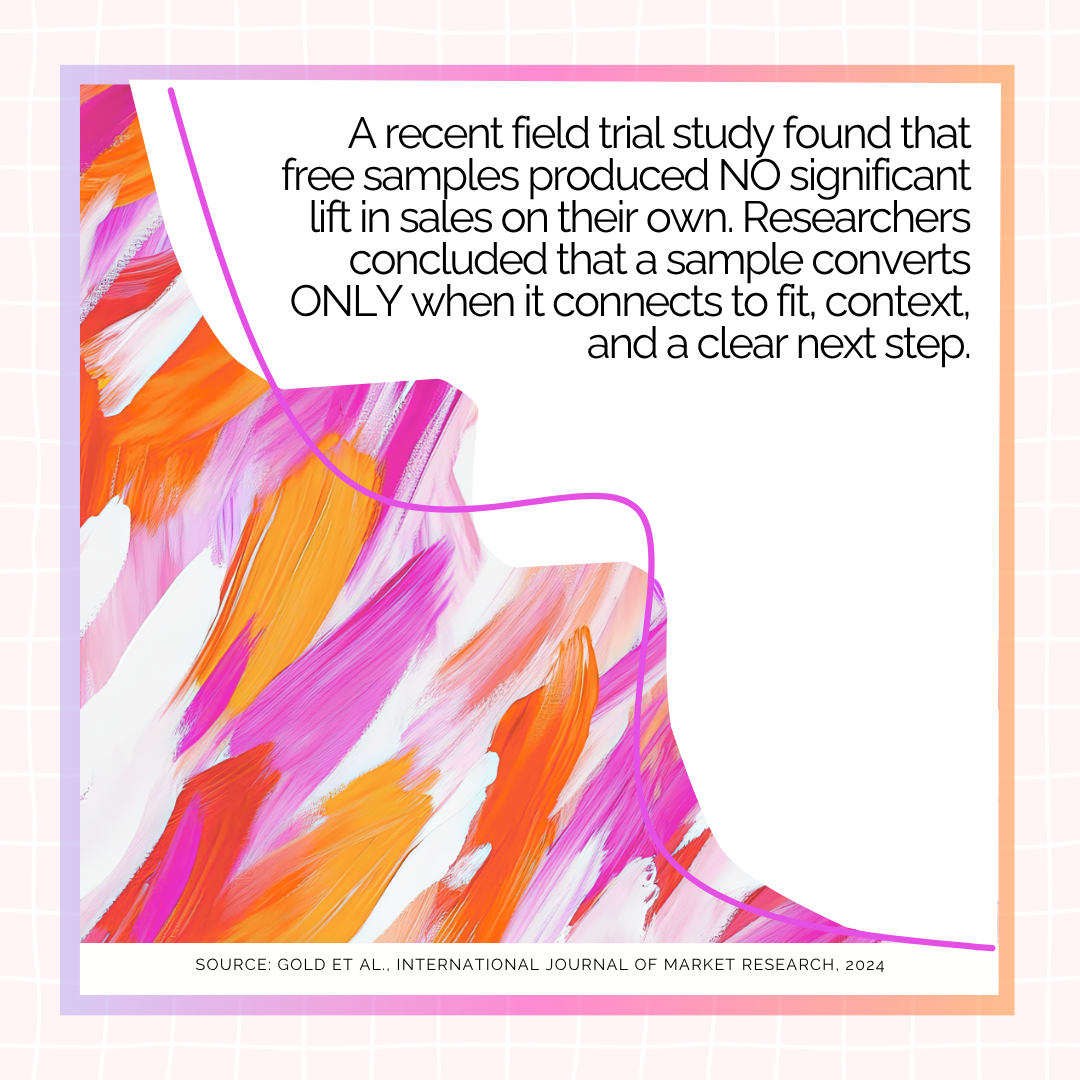
A free taste can lose the sale it was built to win. In 2025, a randomized field experiment followed 680,588 users of a global software platform, and found that longer free trials raised adoption and later conversion while leaving immediate conversion flat.
Researchers concluded that two forces were pulling against each other. The trial teaches a buyer the product's value, and the trial satisfies the very need it was supposed to create.
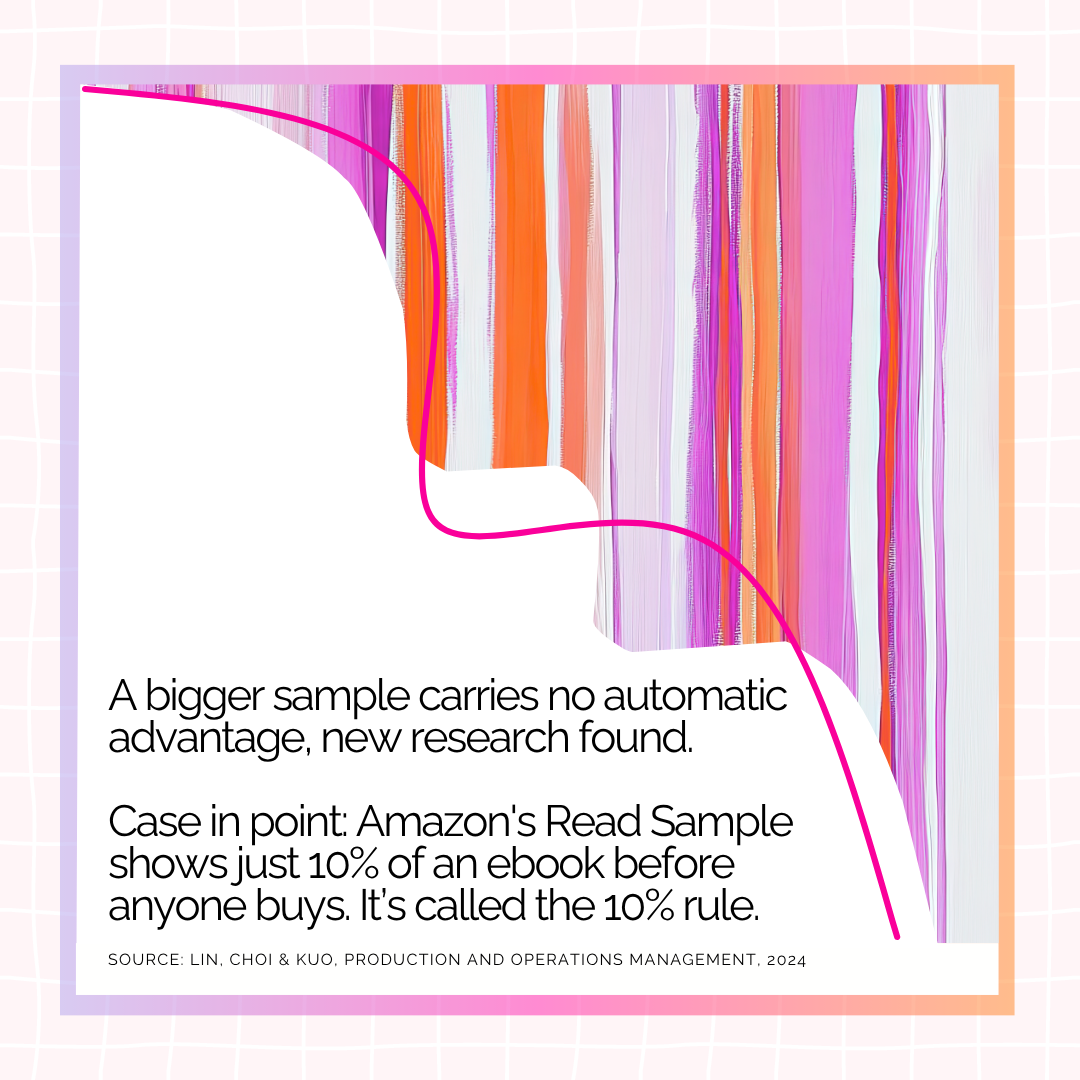
That's called demand cannibalization; when a first taste is generous enough to replace the meal, it removes the reason to order it.
Reference: Schiebler, T., Lee, N., & Brodbeck, F. C. (2026). Journal of the Academy of Marketing Science, 54(1), 91-112.
Let's Help AI Create Your Amuse Bouche
AI Prompts
AI can produce a freebie in minutes. But determining exactly what the free sample should prove is the challenge for you to decide.
Generative tools will hand you a lead magnet, a welcome email, and a delivery sequence faster than you can name them, and every one will be plausible. What no tool can know is which part of your paid experience deserves to be tasted, what your standard looks like on the page, or whether your opt-in promise and your download tell the same story. Diagnosticity is a judgment call, and the judgment stays with you. These three prompts are where you exercise it.
Prompt #1: The Right Proof
Every freebie decision gets easier once one question is answered: which quality of your paid experience should a stranger taste first? This prompt refuses to draft anything until that call is made, and it makes the tool argue the options out loud so your judgment has something to react to.
Ask ChatGPT: "My paid offer is [offer], and buyers value it most for [clarity / structure / templates / coaching presence / other]. I am designing a free resource whose real job is to let the right person sample that quality directly. Do not draft the freebie yet. First, list five different small experiences that would each let a stranger genuinely sample that quality, ranging from a one-page tool to a short recorded walkthrough. For each one, tell me what it proves about the paid experience, what it risks signaling if it turns out mediocre, and how much effort it asks of the user in their first three minutes. Then recommend the one that is most diagnostic of my paid offer and explain your reasoning, so I can make the final call."
Prompt #2: The Kept Promise
A first taste is a sequence: the opt-in promise, the delivery email, the file itself. The promise sets the scale the experience gets graded on, so this prompt walks the chain the way a brand-new subscriber would and reports back where the grade slips.
Ask ChatGPT: "Here is my opt-in page copy: [paste]. Here is my delivery email: [paste]. Here is a description of the freebie itself, including its title, cover, and first page: [describe]. Walk this sequence as a first-time subscriber. At each step, name the expectation the previous step created, then tell me whether this step confirms it, exceeds it, or falls short of it, and why. Pay attention to the felt experience: tone, effort, clarity, and whether each step feels like part of the same considered world. Then give me the smallest set of changes that would make the whole chain read as one kept promise."
Prompt #3: The Three-Minute Win
Usefulness is the most convincing cue a freebie has, and it gets decided in the opening minutes. This one restructures your resource so the first real result arrives early, with nothing standing in its way.
Ask ChatGPT: "Here is the content of my free resource: [paste or outline]. Restructure the experience of using it around one real result a busy stranger can reach in their first three minutes. Tell me what that first win should be, what belongs on the opening page to orient them toward it, what should move later in the document, and what should be cut because it adds volume without adding proof. Then describe how the resource should end: the moment of the completed win, what that moment suggests about my paid offer, and a next step that feels like a natural continuation rather than a pitch. Keep my voice and my content; change the order, the framing, and the amount."
Learn It, Try It: Design The First Taste
Templates
The First Bite Collection runs on the tasting-menu logic of this issue: if one bite is going to carry the whole kitchen's reputation, every element of that bite gets chosen on purpose. The collection covers the three assets doing that carrying, a cover that sets the promise, an opening page that delivers the first win, and a closing page that turns a fresh win into momentum, each built so the visible craft does the signaling and your style layers on top.
Design the bite like the whole menu depends on it, because to a new subscriber, it does.
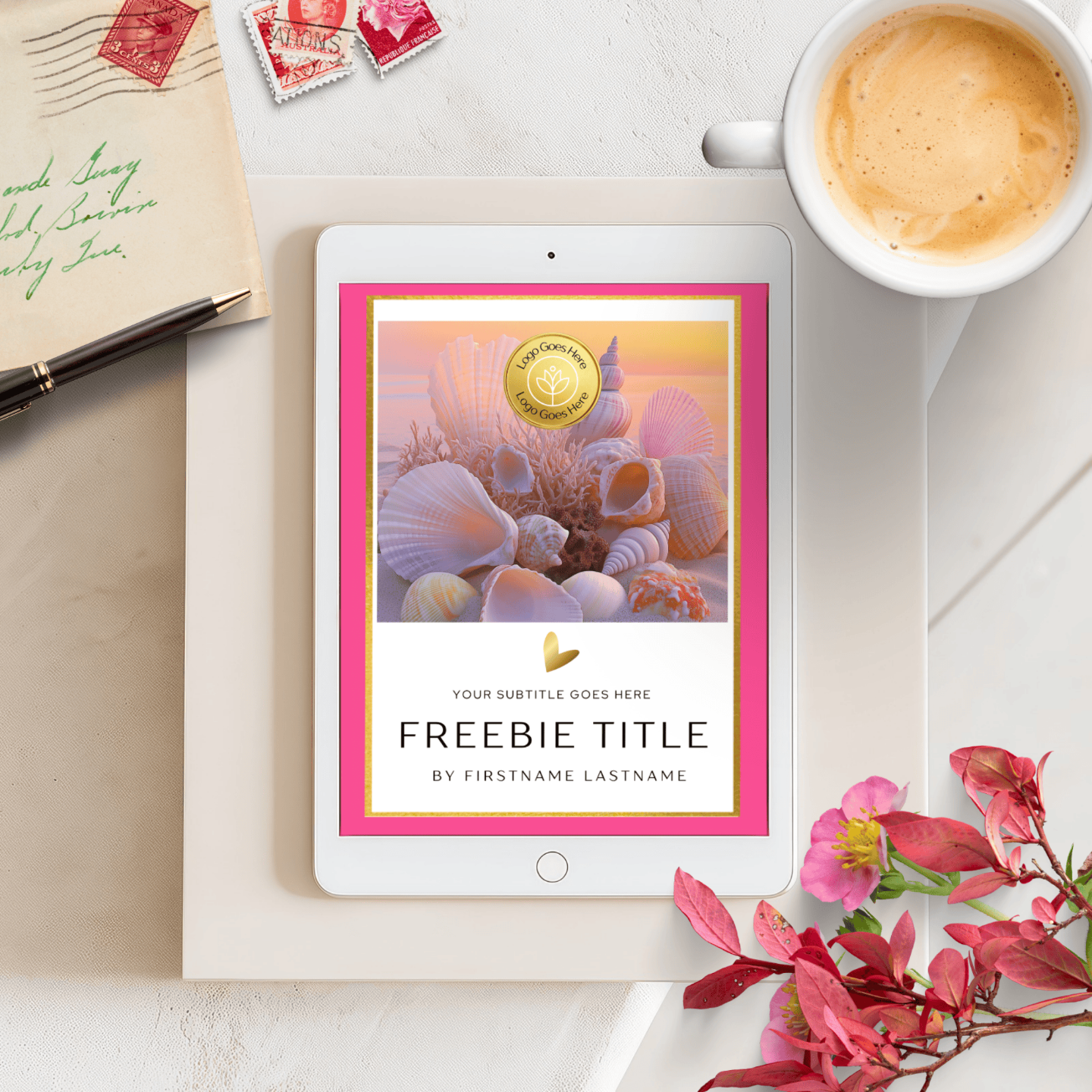
The First Bite Collection—Template One
A Cover Worth Charging For
A freebie cover that reads as a real product and sets a promise the inside can keep.
A cover is the first thing a stranger can actually inspect, and she generalizes it instantly: careful cover, careful method. This template dresses your free resource in the presence of something priced, clear hierarchy, a specific promise, room for your palette, so the expectation it sets is one the inside will happily confirm. Where most freebies read homemade from the shelf, this one introduces itself.
Perfect for:
- Lead magnet covers and opt-in page mockups
- Freebies that currently look homemade next to the paid offer
- Relaunching an existing freebie at a raised standard
Emotional promise: "If this is the free one, just imagine the paid one."
The First Bite Collection—Template Two
[TEMPLATE TWO TITLE · the opening page that delivers the first win]
[One-line promise for the opening-page template.]
[Template Two description: what the opening page proves about the paid experience and how it gets a new subscriber to a real result inside the first three minutes.]
Perfect for:
- [Use case one]
- [Use case two]
- [Use case three]
Emotional promise: "[Promise line.]"
Coming Soon
The Opening Page
The Closing Page
The First Bite Collection—Template Three
[TEMPLATE THREE TITLE · the closing page that turns a fresh win into momentum]
[One-line promise for the closing-page template.]
[Template Three description: how the last page marks the completed win, what that moment suggests about the paid offer, and the next step that reads as a natural continuation.]
Perfect for:
- [Use case one]
- [Use case two]
- [Use case three]
Emotional promise: "[Promise line.]"
Coming Soon
Quick Questions To Ask Yourself
Before You Hit Publish:
The Promise Read
Read your opt-in headline. Open the freebie it delivers. Does the file keep the EXACT promise the headline made? They should read like ONE kept promise.
(Tests Prediction)
Resemblance Test
Next, set the freebie beside your paid offer. Same palette, same care, same voice? A first taste convinces when it truly resembles the meal.
(Tests Recognition)
Three-Minute Bite
Open the file the way a tired buyer would. Does a real win land inside the first three minutes? If the best part sits in the middle, move it to the front.
(Tests Cognitive Effort)

Behind the Designs
Hi, I'm Sidneyeve.
Graphic & Instructional Designer (ID Harvard DCE), Marketing Professor (PhD UMN), Business Coach (ICF PCC)
Thanks for visiting my studio shop.
I'm a marketing professor who studies online buyer behavior and the emotional impact of visual communication. Through Valentine Design Studio, I translate academic insight into visual strategy for solopreneurs who want to promote their work beautifully and persuasively.
My clients are women selling digital offers on their own. They want marketing that looks polished, communicates value clearly, and reflects the care they bring to their work.
Friendly disclaimer: The information in this newsletter is for educational purposes only. I can’t guarantee specific income or other results. Your outcomes depend on your niche, audience, experience, and how you apply what you learn. Always test, tweak, and trust YOUR data. 🎀
Hope you enjoyed this issue!